

Most North Georgia backyards don’t slope a little. They slope enough that the far half of the lawn is functionally decorative — too steep for a table, too awkward for a fire pit, mowed every week and used almost never. This project took exactly that kind of grade and turned the unusable half into the best part of the property.
The finished space is a circular paver patio with a stone fire pit at the center, held in place by a curved segmental retaining wall with a set of stone steps coming down from the house. Every one of those elements exists because of the slope — not in spite of it. That’s the part homeowners tend to miss when they look at a hillside and see a problem.
The Grade Question
When a yard falls away from the house, you have two honest options. You can fight the grade by hauling in fill and hoping it stays put, or you can cut into it, hold the cut with a wall, and end up with a level room that feels intentionally carved out of the hillside. The second approach costs less in material over time and looks dramatically better, because the wall gives the patio a defined edge instead of letting it fade into the lawn.
Cutting into a slope also solves a problem you’d otherwise pay for twice. Fill dirt settles. Georgia clay especially. A patio built on deep fill will move within a few seasons no matter how carefully it was laid, because the ground underneath is still finding its final elevation. Building into undisturbed soil and holding the face with an engineered wall means the patio sits on ground that’s already done settling.
“The wall is doing two jobs at once. It’s holding a hillside back, and it’s giving you a place to put lights, seating, and a defined edge. Homeowners see a wall. We see the reason the patio is possible.”
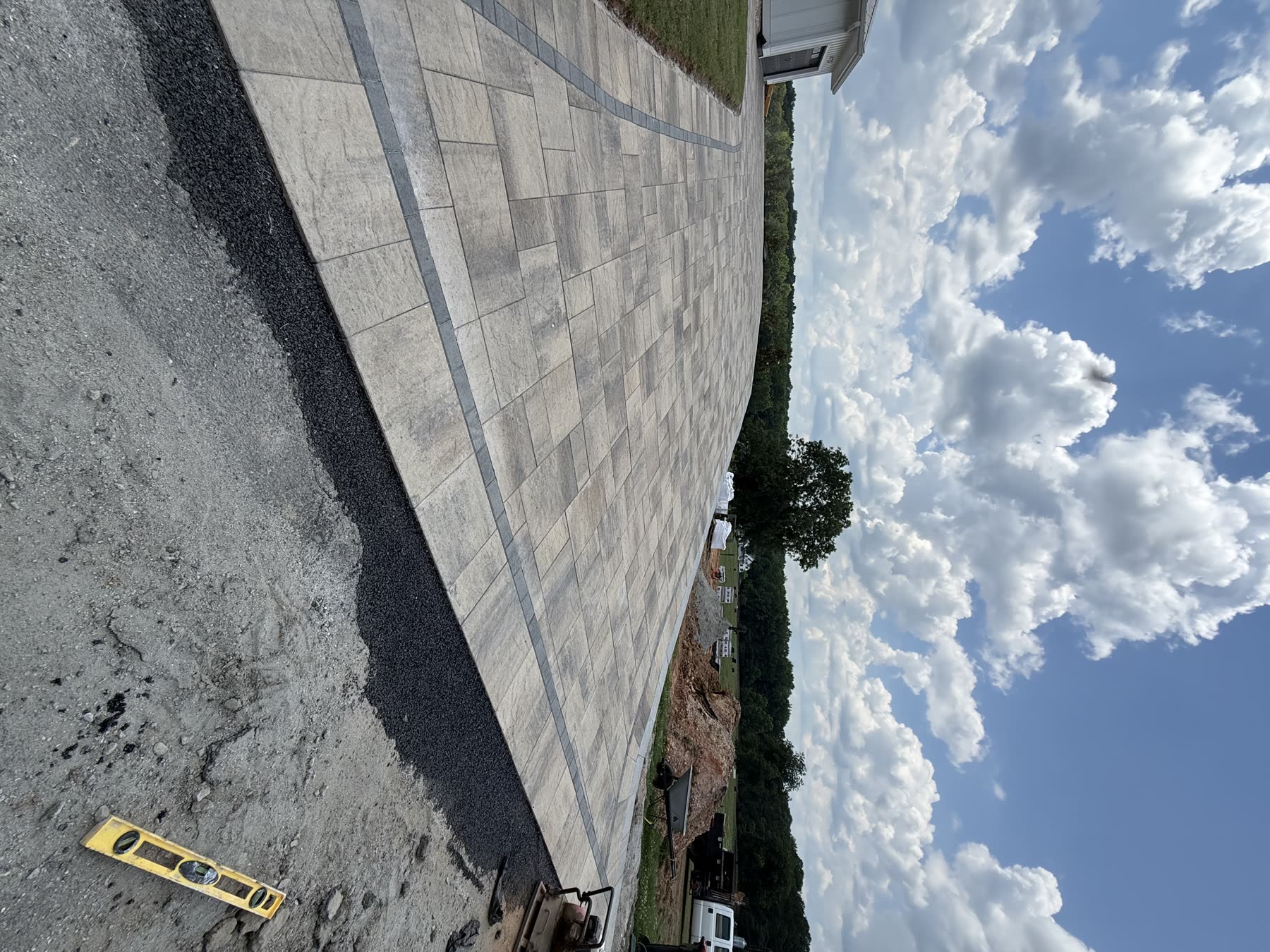
A paver field going down over a compacted, screeded base — with the contrasting border set first to control the pattern all the way to the edge.
A center-set fire pit is the classic layout for a reason: it seats the most people, it looks balanced from the house, and it makes the patio feel like a destination rather than a landing. The trade-off is that a centered fire pit permanently commits the middle of your patio. You are not putting a dining table there later.
So the real question isn’t “where should the fire pit go” — it’s “what is this patio for?” If the answer is conversation, drinks, and cool evenings from September through May, center it and size the field so there’s a comfortable walking lane behind the chairs. If the answer is dinners for eight, put the fire feature off to one side or against the wall and keep the center open. Both are right. Only one is right for you.
On this build the pit is a stone-faced ring with a steel insert and a cooking grate, sized so a standard patio chair sits close enough to feel the heat without anyone’s knees against the stone. That gap sounds like a small detail. Get it wrong by a foot in either direction and the patio either feels crowded or the fire feels distant.
Lighting
Look at the photo at the top of this page. Almost none of that light is coming from a fixture you can see. The wall lights are recessed into the block courses, the step lights are under the treads, and the path lights are set low and aimed down. Nothing shines at eye level, which is exactly why the space feels warm instead of lit.
That’s the whole philosophy of hardscape lighting: you light the surfaces people walk on and the textures worth seeing, and you keep the source itself out of the sightline. A single overly bright flood aimed at a patio will erase every bit of this. Low-voltage LED runs on a transformer, draws almost nothing, and can be zoned so the steps come on early and the wall wash comes on later.
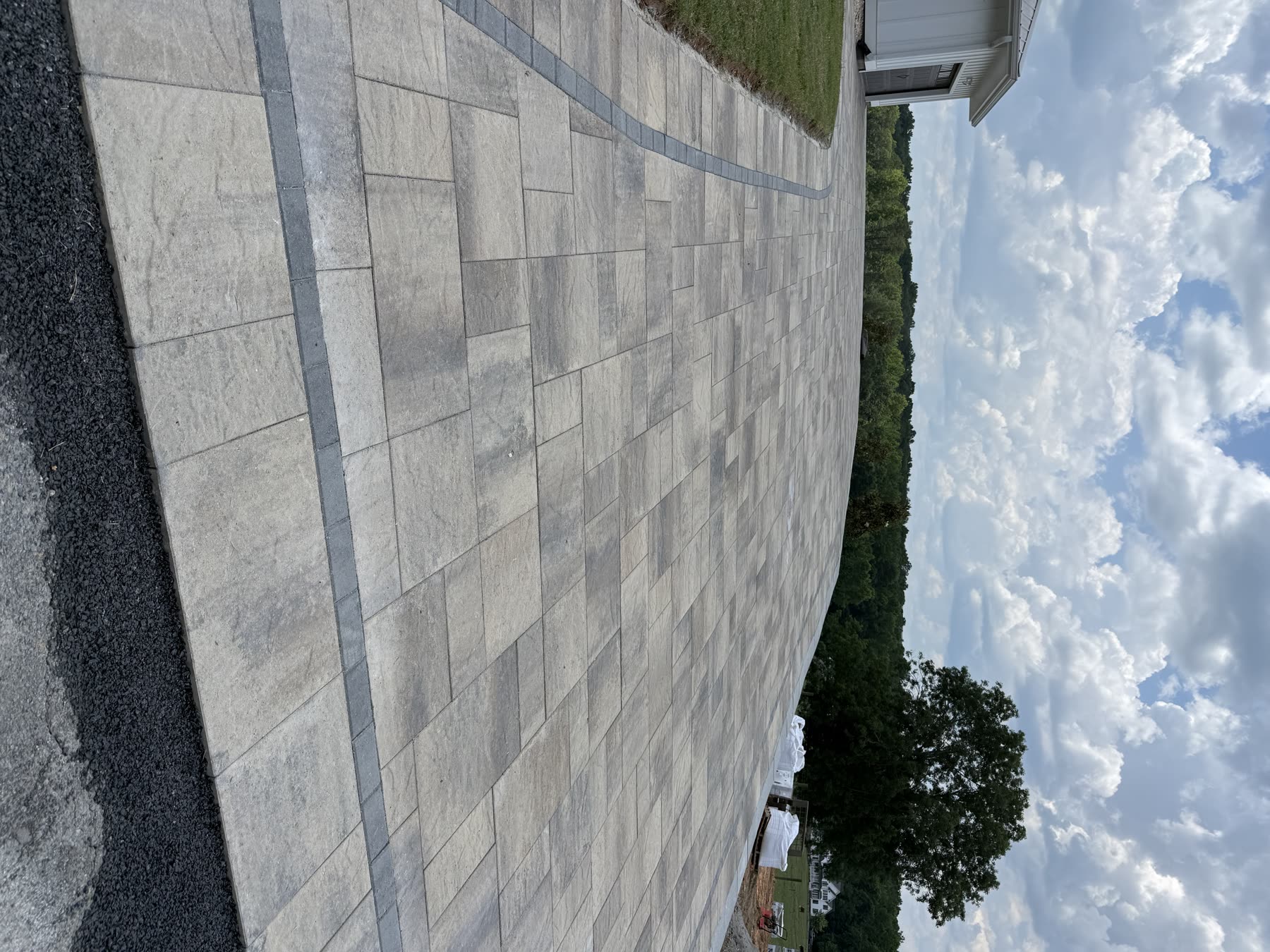
The border course does more than decorate. It locks the field, hides every cut, and gives the eye a clean line where the hardscape ends.
Sloped-lot hardscaping is a heavier build than a flat backyard patio, and it’s fair to know that going in. There’s excavation, there’s spoil to haul off, there’s wall block that has to be delivered and moved by machine, and there’s a base depth behind the wall that nobody will ever see. A comparable patio on flat ground is a simpler job.
What you get back is a space that would not otherwise exist. The area under that patio was a hillside — not a bad patio, not an old deck, just slope. That’s the argument for building into a grade instead of leveling around it: you’re not upgrading square footage you already had, you’re adding usable outdoor room to the property.
If your backyard falls away from the house and you’ve written it off, it’s worth a second look. The steeper it is, the more dramatic the finished space usually turns out — because the wall that makes it possible is also the thing that makes it feel built rather than poured.
Kaizen Scapes proudly serves homeowners across Canton, GA, Woodstock, GA, and the surrounding North Georgia communities including Holly Springs, Ball Ground, Acworth, Kennesaw, Marietta, Alpharetta, Milton, Roswell, Cumming, Johns Creek, and East Cobb. If you’re looking for hardscaping and landscaping craftsmanship within 35 miles of Canton or Woodstock, our team is ready to transform your outdoor space.
Whether you’re in Canton, Woodstock, Alpharetta, Milton, or anywhere across Cherokee County and the greater North Atlanta suburbs, Kaizen Scapes brings the same relentless standard to every project. We don’t do cookie-cutter. We do custom — built to last.
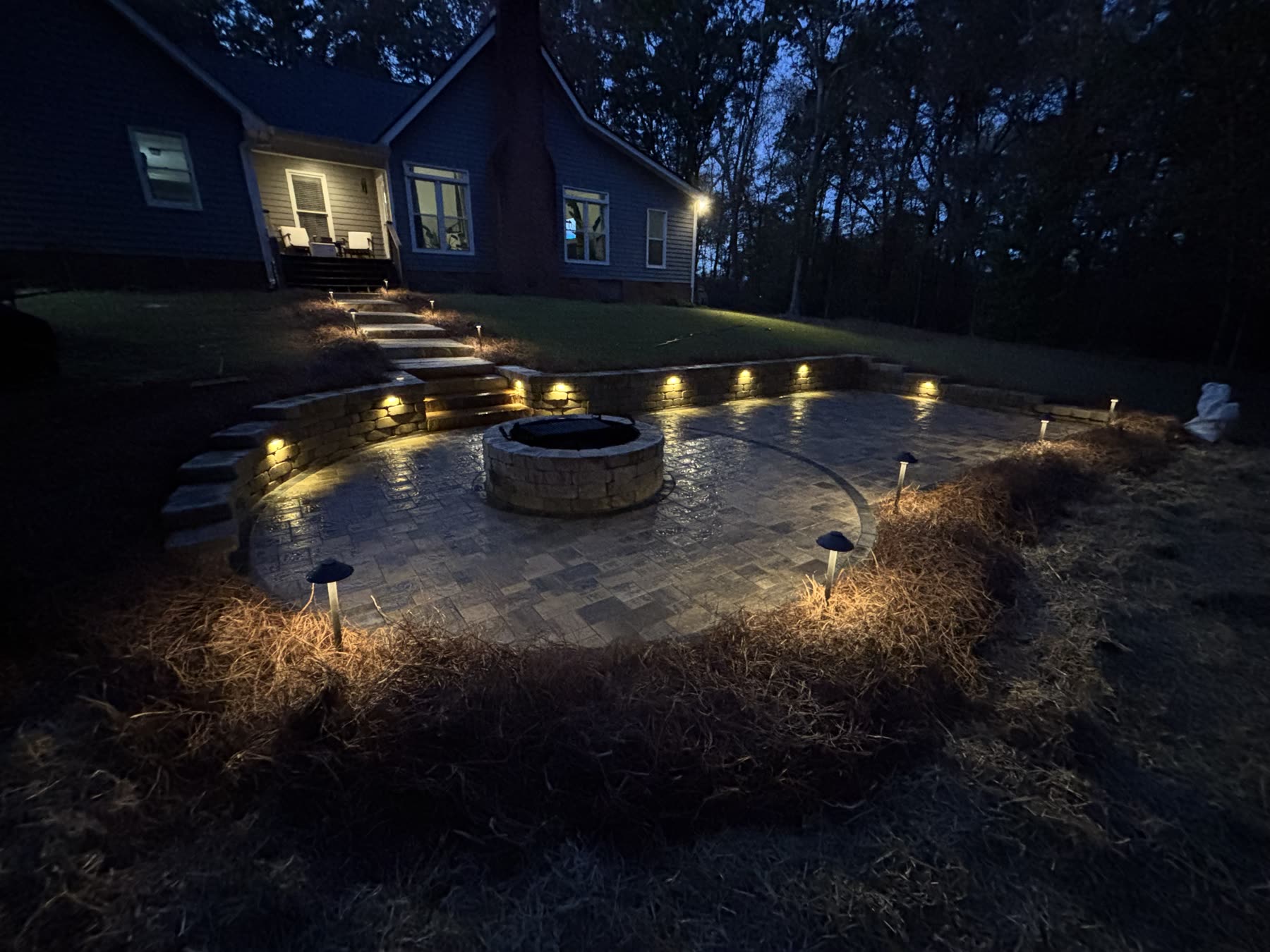
The finished space after dark — wall lights recessed into the block, step lights under the treads, and not a single fixture in your eyeline.
That grade is usually the reason a great patio is possible, not the reason it isn’t. We’ll walk the site and show you what’s actually buildable. Free site evaluations across all of North Georgia.
Kaizen Scapes is based in Canton, Georgia and serves the greater North Atlanta region within 35 miles: