

A patio you can only use on a perfect day is a patio you barely use. That’s the honest reason so many North Georgia homeowners are asking for a covered pavilion and a large-format paver patio at the same time — one solves the weather, the other solves the floor, and together they turn a back door into a room you actually live in.
We built the project you’re looking at as a single system, not two separate jobs. The pavilion and the paver field were laid out together, drained together, and finished together — which is exactly why the covered area and the open area read as one continuous surface instead of a porch with a patio bolted onto it. Here’s how that decision plays out, and what it means if you’re weighing the same thing for your own backyard.
The Real Problem
North Georgia gives you a genuinely long outdoor season — and then interrupts it constantly. Afternoon thunderstorms in July, pollen season in April, and full overhead sun from noon to four are the three things that quietly kill patio usage. Homeowners don’t stop wanting to be outside. They just stop walking out there, because the space only works under narrow conditions.
A covered structure changes the math immediately. Shade drops the usable temperature of a seating area by a noticeable margin, and a roof means a sudden storm ends a conversation instead of ending the evening. Add a ceiling fan — like the one in this pavilion — and you’ve extended comfortable use through the hottest weeks of a Georgia summer. That’s not a luxury upgrade. That’s the difference between a patio you use twice a month and one you use four nights a week.
“The covered part and the open part have to be planned as one floor. The moment you build the roof first and figure out the patio later, you inherit every elevation problem the structure created.”
Material Choice
Large-format pavers — the wide, square-cut units you see across this project — do something small pavers can’t. Fewer joints across the same square footage means the eye reads the floor as a single plane, which makes a covered area feel like an interior room rather than an outdoor slab. Under a pavilion, where you’re standing in a defined space with a ceiling above you, that effect is dramatic.
There’s a practical side too. Fewer joints means less joint sand to maintain, fewer places for organic debris to settle, and a faster cleanup after Georgia’s pollen weeks. A covered area also stays drier than an open one, which means the paver surface under the roof holds its finish longer and needs sealing less often than the field sitting in full weather.
Large-format units are less forgiving of a sloppy base. A small paver can absorb a minor imperfection across a dozen joints; a large unit telegraphs it as a rock or a lip. That’s why a large-format installation lives or dies on base preparation — compacted aggregate, proper depth, and a screed bed that’s genuinely flat, not approximately flat. When homeowners tell us a large-format patio somewhere else “moved,” the pavers almost never moved. The base did.
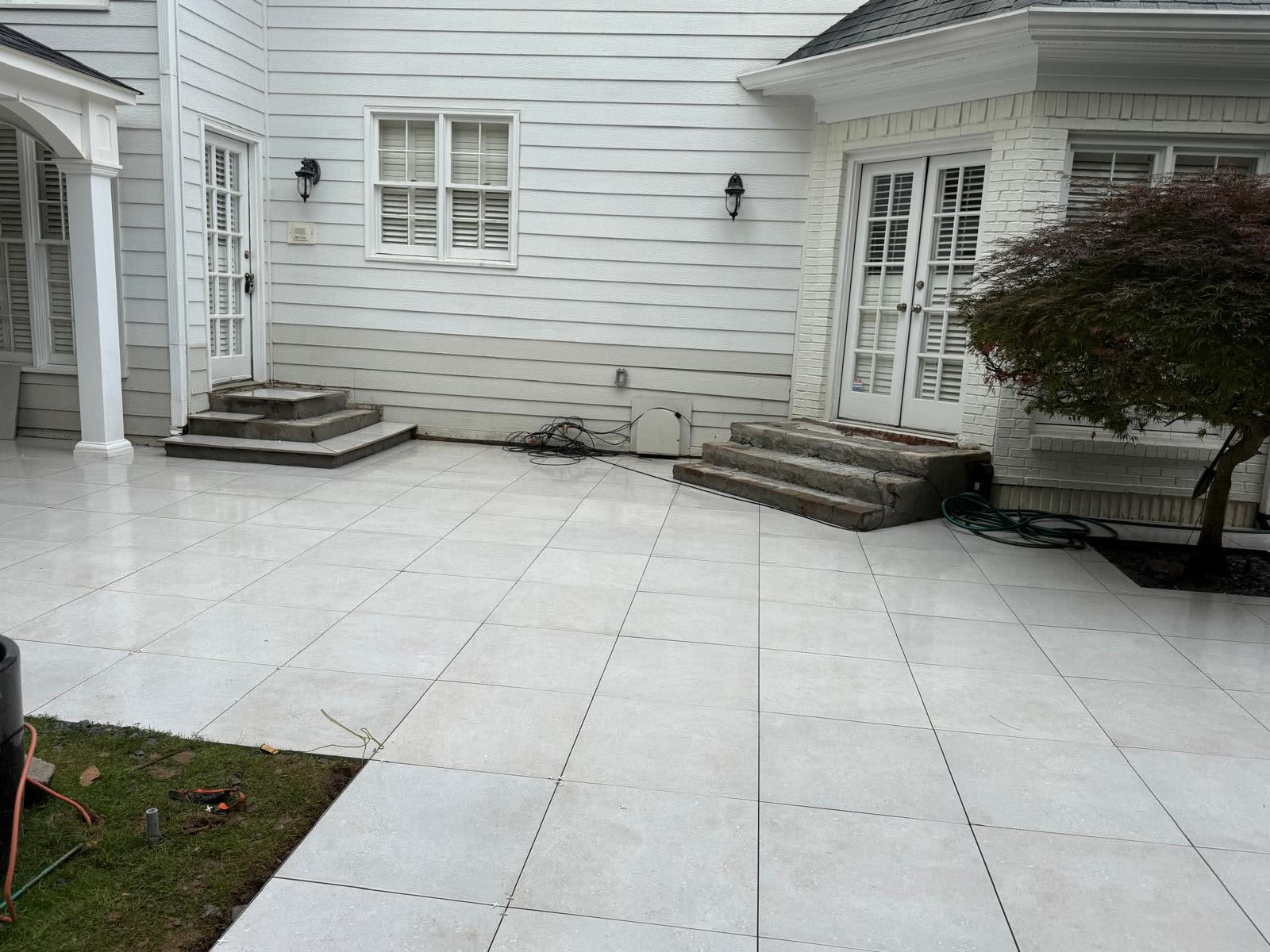
The same paver runs from under the pavilion out into the open field — no threshold, no color break, one continuous floor.
The sequence matters more than most homeowners expect. Footings for the pavilion columns go in before any paving, and they’re placed with the finished paver elevation already calculated — so the column bases land flush and clean instead of sitting proud of the floor with a caulk line around them. Getting that wrong is one of the most common tells of a structure and a patio built by two different crews on two different schedules.
From there the base goes in across the full footprint, covered and open, as one continuous system. Compaction happens in lifts, not all at once, because a deep layer compacted in a single pass looks tight on top and stays loose underneath. The screed bed is set, the field is laid working out from a controlled starting line, and the perimeter is cut last so the edges land where they should instead of where the pattern happened to stop.
Then comes the part nobody photographs: joint stabilization, edge restraint, and a final compaction pass that seats every unit into the bedding layer. It’s the least glamorous half-day of the project and the single biggest reason a patio still looks like this in year eight.
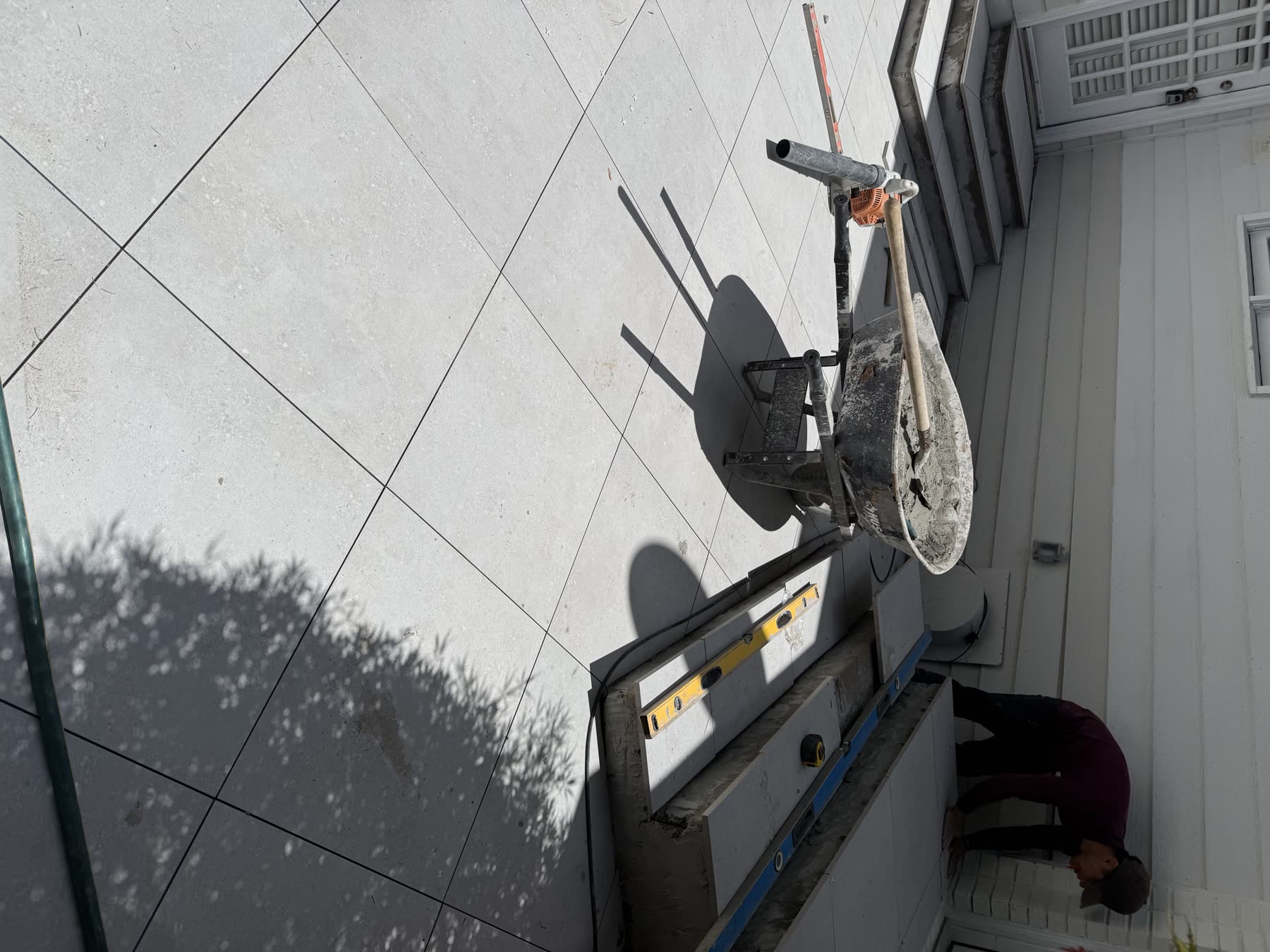
Mid-installation: levels, screed rails, and a bedding layer worked in sections. Large-format pavers are unforgiving of a base that’s only close.
This combination is a strong fit if you already have a back door that opens onto nothing, if your existing patio bakes in afternoon sun, or if you’ve been putting off outdoor furniture because you don’t want to drag cushions inside every time the forecast turns. It’s also the right call if you entertain — a covered zone plus an open zone lets a group spread out without anyone being stuck in the sun or crowded under the roof.
It’s probably not the right call if your budget only covers one of the two done well. We’d rather build you an excellent paver patio now and add the pavilion next season than stretch a single budget across both and compromise the base or the framing. A patio built right is permanent. A patio built to hit a number gets rebuilt.
Kaizen Scapes proudly serves homeowners across Canton, GA, Woodstock, GA, and the surrounding North Georgia communities including Holly Springs, Ball Ground, Acworth, Kennesaw, Marietta, Alpharetta, Milton, Roswell, Cumming, Johns Creek, and East Cobb. If you’re looking for hardscaping and landscaping craftsmanship within 35 miles of Canton or Woodstock, our team is ready to transform your outdoor space.
Whether you’re in Canton, Woodstock, Alpharetta, Milton, or anywhere across Cherokee County and the greater North Atlanta suburbs, Kaizen Scapes brings the same relentless standard to every project. We don’t do cookie-cutter. We do custom — built to last.
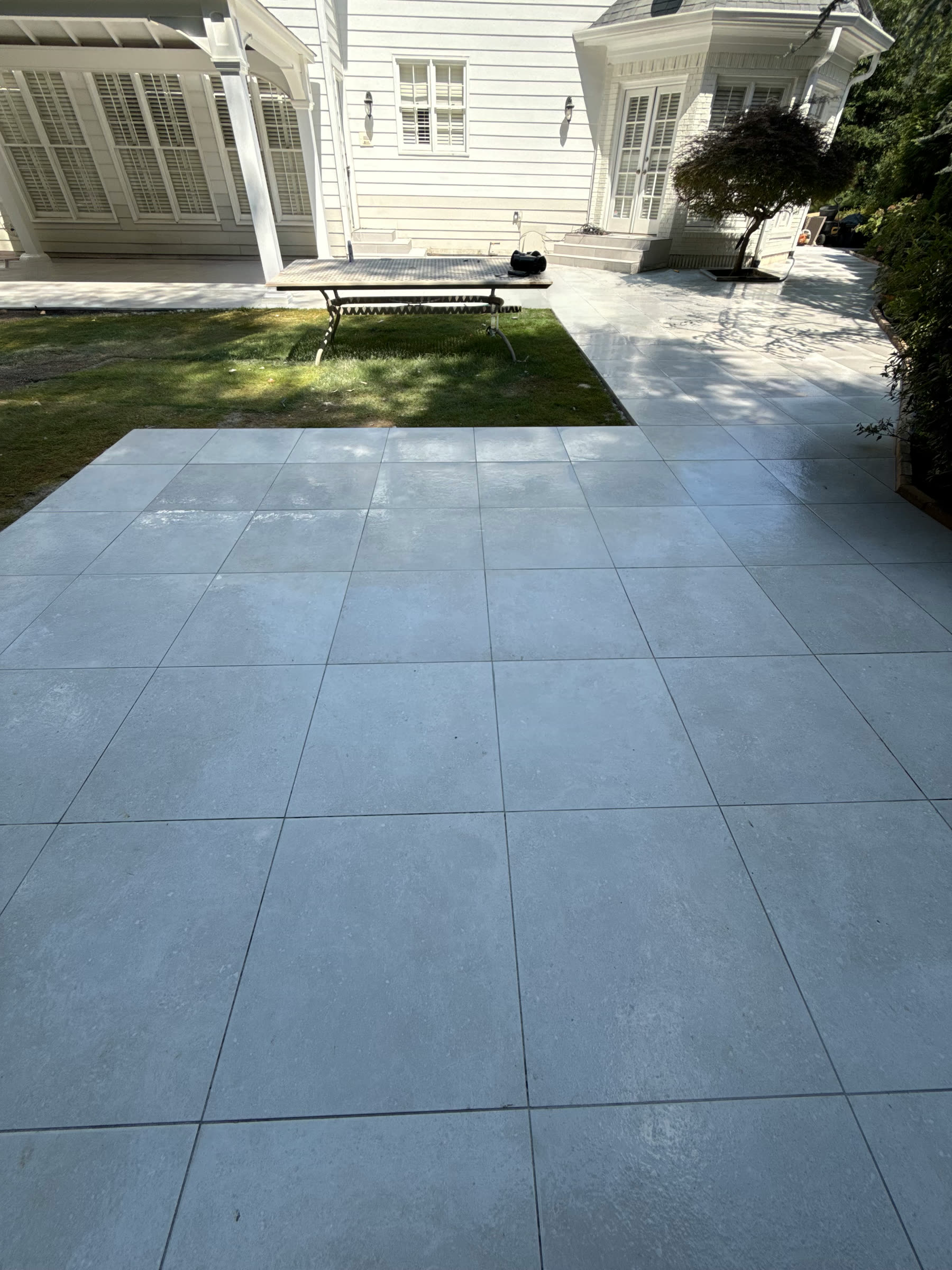
The open half of the same floor. Pitched away from the house, joints stabilized, and set on a base built to hold its line through Georgia’s clay season.
We’ll walk your site, check your rooflines and drainage, and tell you honestly whether a pavilion, a pergola, or just a better patio is the right first move. Free site evaluations across all of North Georgia.
Kaizen Scapes is based in Canton, Georgia and serves the greater North Atlanta region within 35 miles: