

A brand-new house comes with a brand-new problem: the builder graded the lot to shed water off the foundation and stopped there. Everything past that — how you walk to the door, how you get down the grade, and where all that water actually goes — is left for you. This project is what solving all three at once looks like.
What you’re looking at is a paver walkway with cut stone step treads, a charcoal soldier-course border, and a river-rock drainage channel running along both sides. It reads as a design choice. It’s actually a drainage system that happens to be beautiful. That’s the ideal outcome on a new-construction lot, and it’s a lot cheaper to build now than to retrofit after the landscaping is in.
The New-Build Reality
Builder grading is a code-and-warranty exercise, not a landscape plan. The goal is positive slope away from the foundation and a lot that drains somewhere off the pad — which is very different from a lot that drains somewhere useful. On a North Georgia site with red clay and a real elevation change, “somewhere off the pad” usually means a channel carved across the future lawn every time it rains hard.
Then there’s the ground itself. A new lot has been driven on by heavy equipment for months, which compacts some areas into concrete and leaves other areas as loose backfill that will settle for another year or two. Straw and fresh seed hide all of it. The first homeowner to discover the difference is usually the one who put a walkway down without addressing the base underneath.
“On a new build, the cheapest time to solve drainage is before the sod truck shows up. The most expensive time is two summers later, when you’re tearing up a lawn you already paid for.”
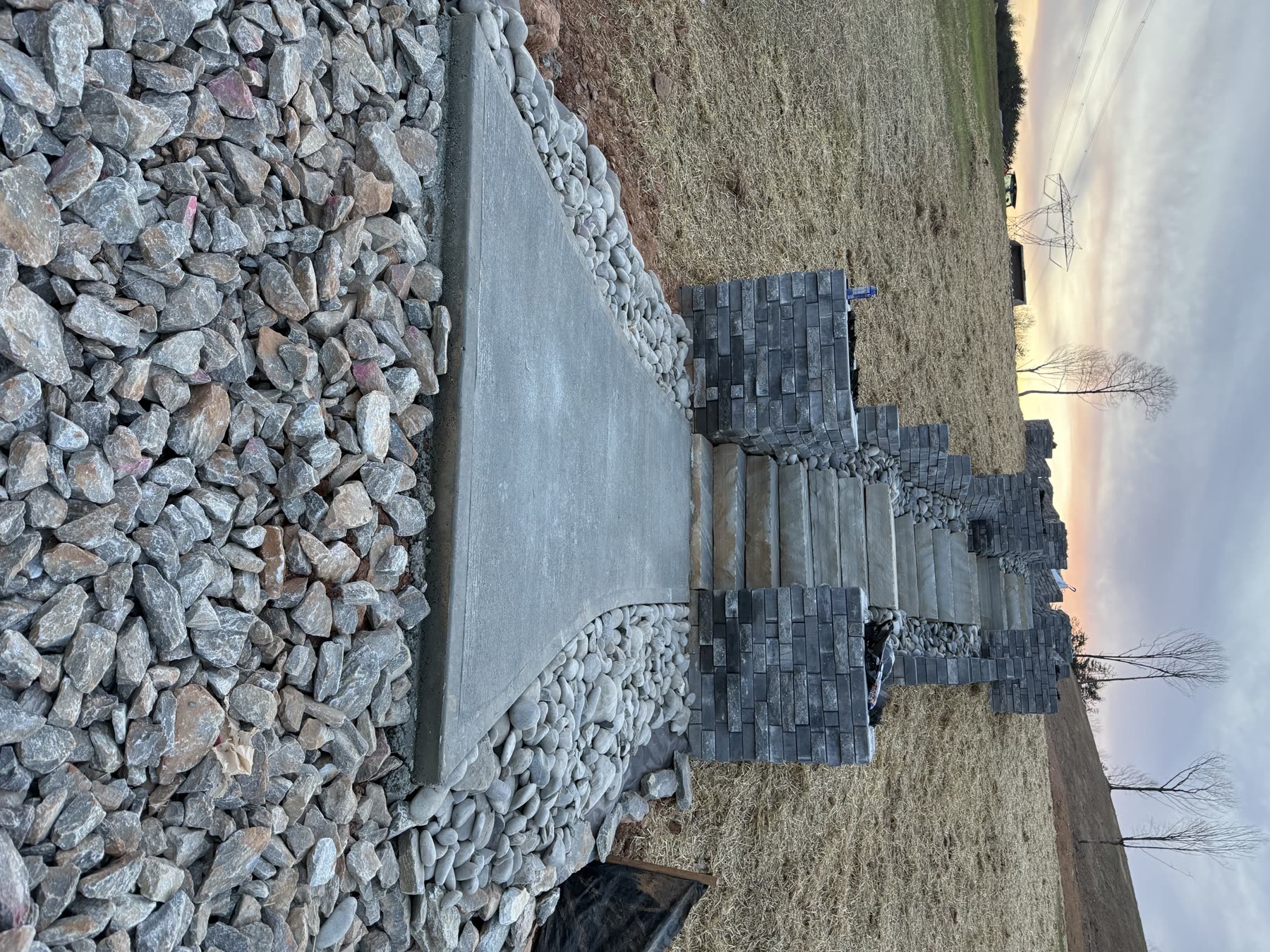
The full run: cut stone treads stepping down the grade, charcoal soldier course on both edges, and river rock channels carrying water alongside instead of across.
A buried french drain is invisible, which sounds like an advantage until something goes wrong. An open river-rock channel does the same work — carrying and slowing water — while staying completely inspectable and essentially maintenance-free. You can see it working. You can rake a leaf out of it. Nothing silts up inside a pipe you can’t reach.
It also handles the specific thing North Georgia does to a new lot. Hard rain on bare clay produces fast, dirty sheet flow, and fast water is what carves ruts and undermines edges. A rock channel spreads that flow out, slows it down, and drops the sediment where you can see it instead of where it will clog something. The channel becomes the sacrificial layer that protects the hardscape.
The visual trick is the size grading of the stone and the crispness of the edge holding it. Rounded river rock against a hard charcoal border reads deliberate; the same rock spilling into mulch reads like a repair. The border course does the heavy lifting — it holds the channel line, it holds the paver field, and it gives the whole run a finished edge on both sides.
Steps
Steps are where most DIY and low-bid walkway projects fail, and the reason is almost always the same: inconsistent rise. A run of steps where the treads vary by even three-quarters of an inch is something people trip on at night, every time, for the life of the house. Consistent rise across the whole run is not a craftsmanship flourish. It’s the safety spec.
On a fresh lot there’s a second issue. The soil beside and beneath the step run is still consolidating, so a step set directly on graded dirt will drop. Every tread here sits on compacted aggregate, and the bottom step lands on the paver field rather than on soil — which means there’s no point along the run where erosion can undercut a tread and open a gap.

Close up on the detail that carries the whole design: solid cut treads, tight border, and graded river rock holding both edges.
The single best piece of advice we can give a new-construction homeowner in North Georgia is about order of operations. Hardscape and drainage first, irrigation second, planting and sod last. Every one of those steps disturbs the ground, and doing them out of order means paying to repair the previous one.
It’s also the cheaper sequence. Machines can still reach the work area, there’s nothing established to protect, and spoil can be moved without threading a mini-excavator between finished beds. The same walkway installed after full landscaping frequently costs more in access, protection, and repair than the walkway itself.
If your house is finished but your yard is still raw dirt and straw, you’re at the ideal moment. That window doesn’t last long — it closes the day the sod goes down.
Kaizen Scapes proudly serves homeowners across Canton, GA, Woodstock, GA, and the surrounding North Georgia communities including Holly Springs, Ball Ground, Acworth, Kennesaw, Marietta, Alpharetta, Milton, Roswell, Cumming, Johns Creek, and East Cobb. If you’re looking for hardscaping and landscaping craftsmanship within 35 miles of Canton or Woodstock, our team is ready to transform your outdoor space.
Whether you’re in Canton, Woodstock, Alpharetta, Milton, or anywhere across Cherokee County and the greater North Atlanta suburbs, Kaizen Scapes brings the same relentless standard to every project. We don’t do cookie-cutter. We do custom — built to last.
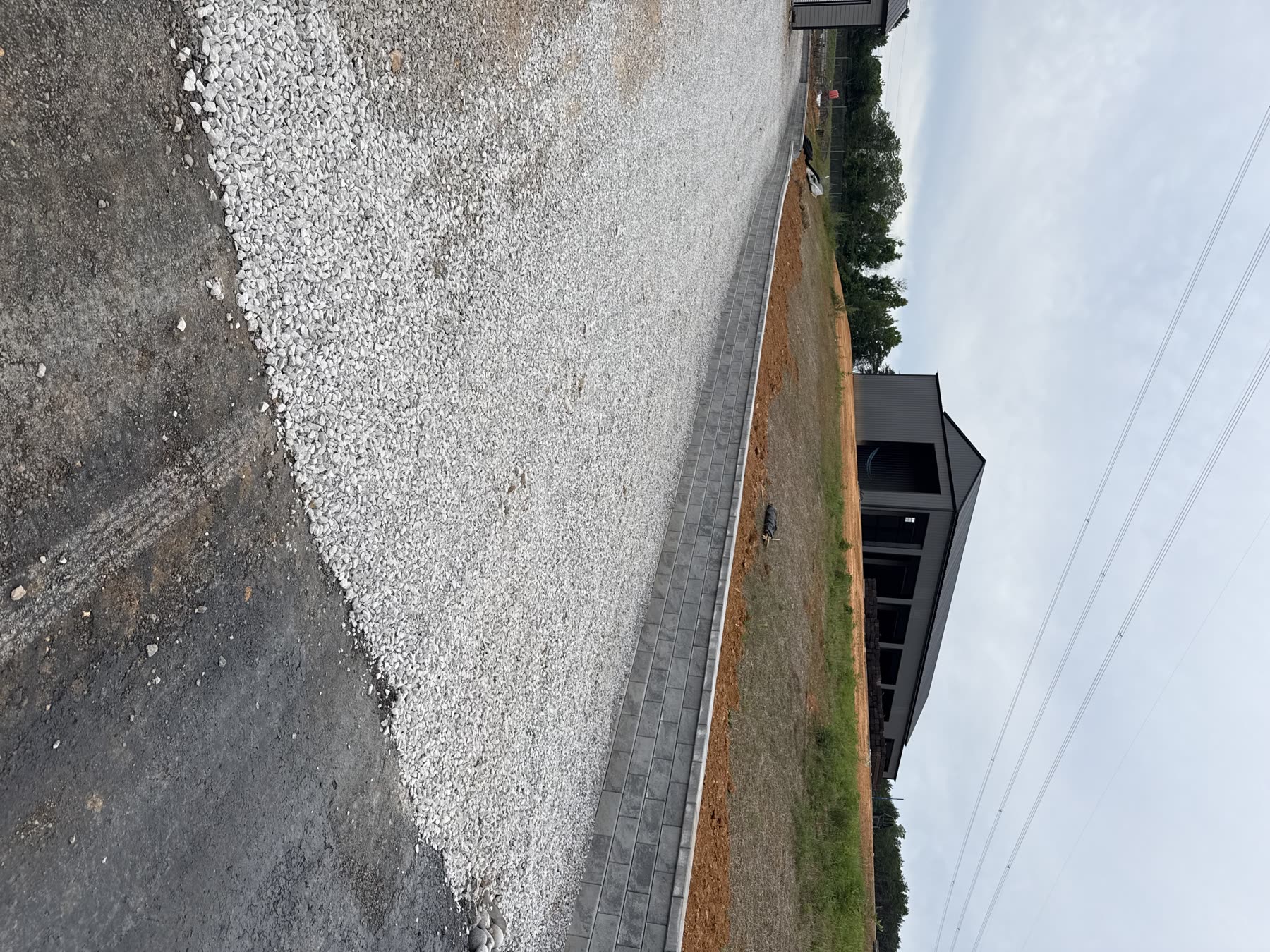
The same principle at the drive: a hard border set first, base stone placed and compacted, and the water given somewhere to go before anything final gets built on top.
This is the cheapest and easiest moment in your home’s life to get walkways, steps, and drainage right. We’ll map where your water actually goes. Free site evaluations across all of North Georgia.
Kaizen Scapes is based in Canton, Georgia and serves the greater North Atlanta region within 35 miles: